
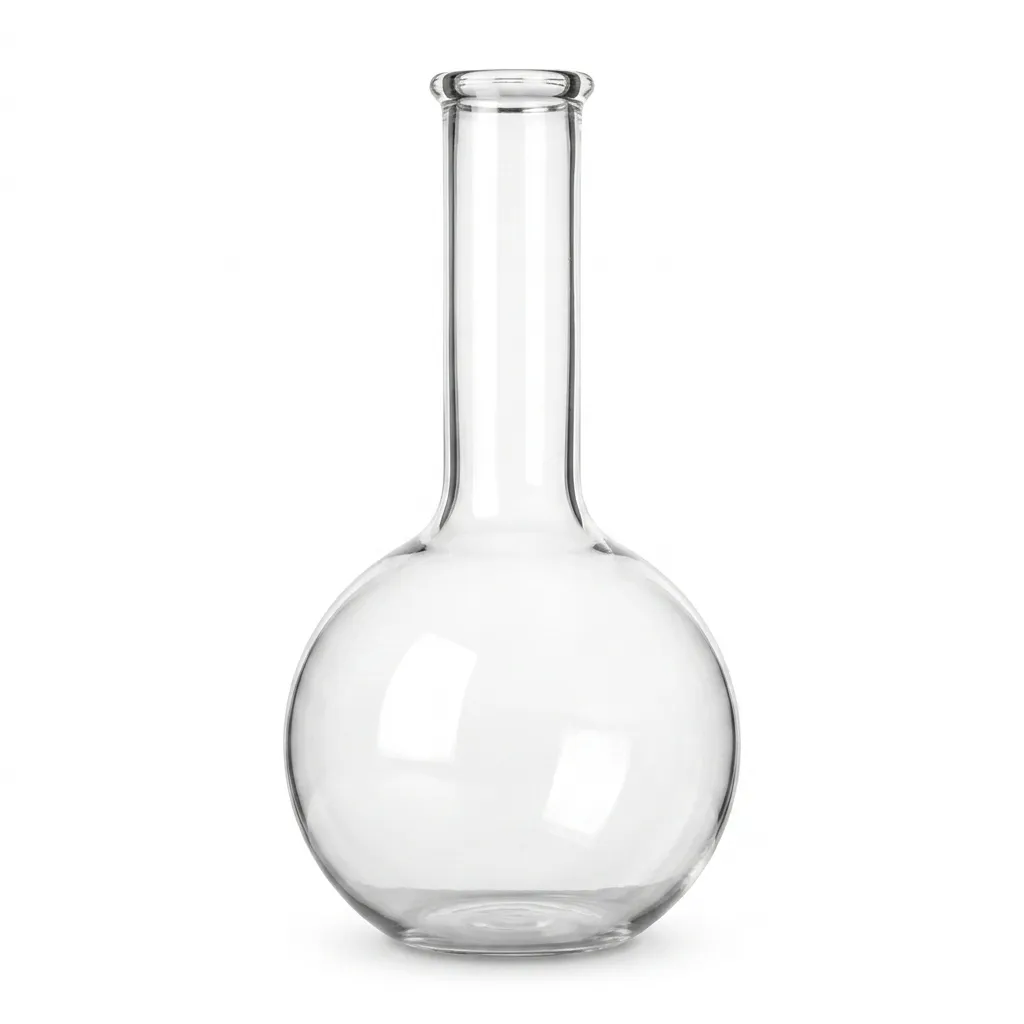
Description
Boiling flasks are specialized laboratory vessels designed for uniform heating, boiling, distillation, and chemical reactions. These are typically manufactured from Borosilicate 3.3 Glass to withstand high temperatures and rapid thermal changes.
Depending on the application, you will choose between a Flat Bottom (F/B) or a Round Bottom (R/B) configuration.
1. Flat Bottom (F/B) Boiling Flask
The flat bottom allows the flask to stand upright on a flat surface, such as a lab bench or a hotplate, without the need for a support ring.
-
Best For: Heating liquids on a heating mantle or hotplate, preparing solutions, and general laboratory storage.
-
Advantage: Convenience. It is stable on flat surfaces.
-
Limitation: The flat base creates “stress points” where the glass meets the flat surface, making it slightly less resistant to high-pressure differentials compared to round-bottom flasks.
Common Features
-
Material: Borosilicate 3.3, providing a low coefficient of expansion and high resistance to chemical attack.
-
Neck Options:
-
Narrow Neck: Standard design for boiling and minimizing evaporation.
-
Ground Glass Joint: Features a frosted “joint” (e.g., 24/29 or 29/32) to allow for airtight connections with condensers and other modular glassware.
-
-
Beaded Rim: Reinforced top edge to prevent chipping and increase durability.
Technical Specifications
| Capacity (ml) | Neck Type | Approx. Height (mm) | Max Temperature |
| 100ml | Narrow/Jointed | 105 – 115 | 500°C |
| 250ml | Narrow/Jointed | 140 – 150 | 500°C |
| 500ml | Narrow/Jointed | 165 – 180 | 500°C |
| 1000ml (1L) | Narrow/Jointed | 200 – 210 | 500°C |
| 2000ml (2L) | Narrow/Jointed | 250 – 260 | 500°C |
Usage Tips
-
Heating: When using a Bunsen burner, always use a wire gauze to distribute the heat and prevent “hot spots” that could cause the glass to fail.
-
Stirring: The round-bottom shape is particularly effective for magnetic stirring in reflux setups as it allows for better vortex creation.
-
Safety: Never heat a flask that is tightly sealed; always ensure there is a vent (like a condenser or a drying tube) to prevent pressure buildup.



Reviews
There are no reviews yet.