

Description
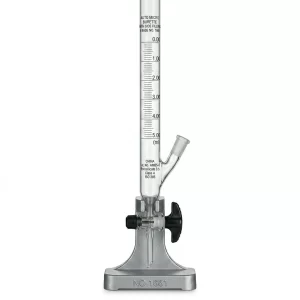
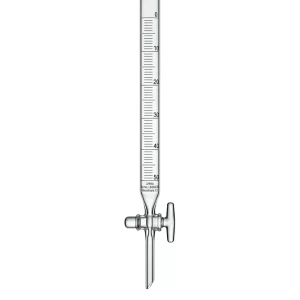
A Straight Glass Stopcock Burette is a precision volumetric instrument used in analytical chemistry for the accurate dispensing of liquids, most commonly in titration procedures. This model features a classic ground-glass stopcock, which provides a traditional and highly durable control mechanism for drop-by-drop delivery.
Key Product Features
-
Precision Borosilicate 3.3 Glass: Manufactured from low-expansion glass that is highly resistant to chemical corrosion from both acids and alkalis, ensuring the internal volume remains calibrated even after repeated cleanings.
-
Ground-Glass Straight Stopcock: * Features a precision-ground glass plug that fits perfectly into the barrel.
-
Offers a classic “feel” and high durability.
-
Requires a thin layer of vacuum grease or stopcock lubricant to ensure a leak-proof seal and smooth rotation.
-
-
High-Contrast Graduations: Permanent white or blue enamel markings are fired into the glass for maximum visibility against clear or colored liquids.
-
Accurate Calibration: Typically calibrated “To Deliver” (TD/Ex) at 20°C, ensuring that the volume dispensed matches the scale reading.
-
Reinforced Tips: The delivery tip is precision-pulled and reinforced to resist chipping and ensure a consistent, reproducible drop size.
Technical Specifications
| Capacity (ml) | Subdivisions (ml) | Tolerance (Class A) | Tolerance (Class B) |
| 10ml | 0.05 | ± 0.02ml | ± 0.05ml |
| 25ml | 0.10 | ± 0.03ml | ± 0.05ml |
| 50ml | 0.10 | ± 0.05ml | ± 0.10ml |
| 100ml | 0.20 | ± 0.10ml | ± 0.20ml |
Primary Applications
-
Acid-Base Titrations: The most common use, allowing for the precise measurement of a titrant required to reach a pH endpoint.
-
Redox Titrations: Used in the determination of concentration for oxidizing or reducing agents.
-
Standard Solution Preparation: Ideal for dispensing specific, high-accuracy volumes of reagents into flasks.
-
Volumetric Analysis: Essential for any quantitative chemical analysis where the volume of liquid used must be known to a high degree of precision.
Maintenance & Best Practices
-
Lubrication: Since the stopcock is glass-on-glass, it must be lubricated with a small amount of silicone-based stopcock grease. Avoid over-greasing, as this can clog the delivery tip.
-
Cleaning: Always clean the burette immediately after use, especially when using alkaline solutions (like NaOH), which can cause the glass stopcock to “freeze” or seize if left for long periods.
-
Reading the Meniscus: For clear liquids, read the volume at the lowest point of the curve (the bottom of the meniscus) at eye level to avoid parallax errors.
-
Storage: Store the burette vertically in a burette stand or rack. It is recommended to loosen the stopcock slightly during long-term storage to prevent sticking.
Why Choose a Glass Stopcock?
While PTFE (Teflon) stopcocks are popular because they do not require grease, glass stopcocks remain a staple in many professional labs due to their superior resistance to organic solvents and their long-term mechanical stability. When properly maintained, a glass stopcock provides the most reliable and consistent flow control for high-precision analytical work.

Reviews
There are no reviews yet.