
Description
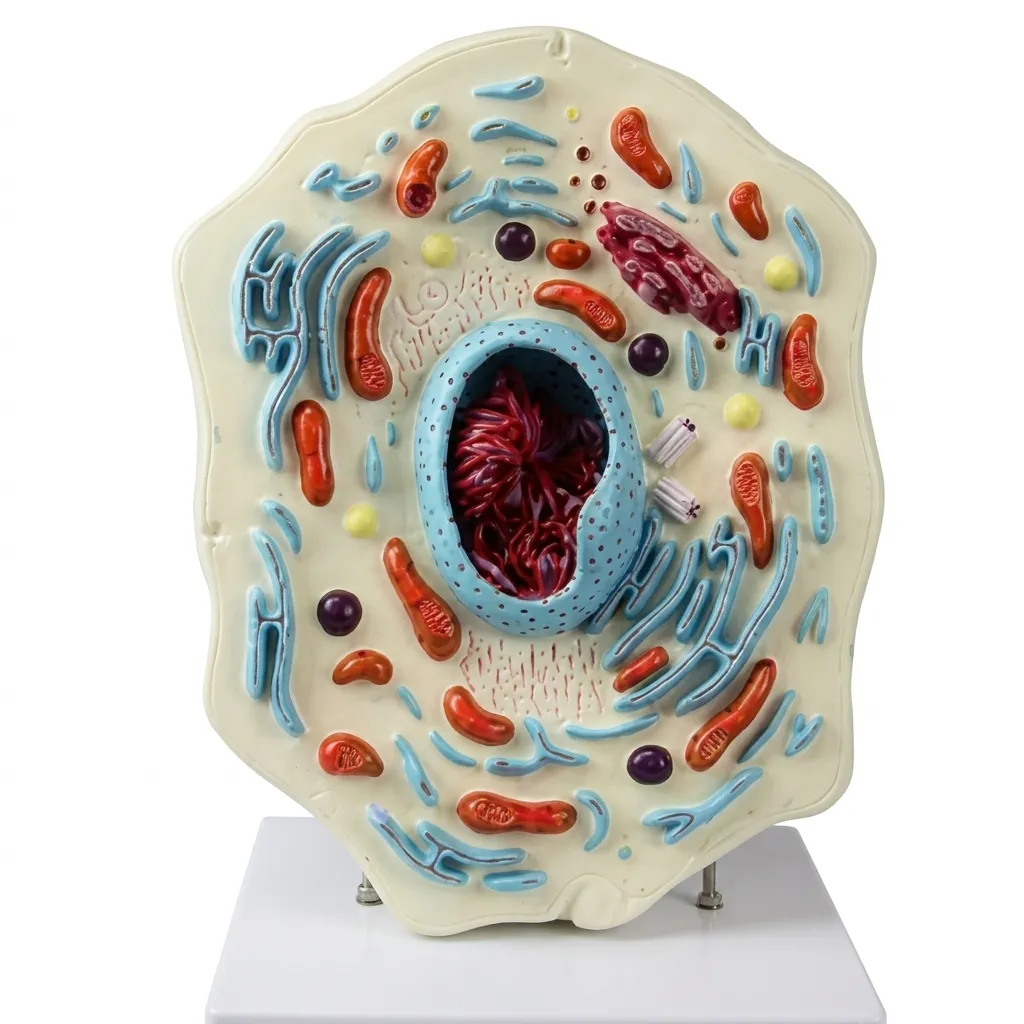
The J3201-1 Plant Cell Model is a high-quality, enlarged representation of a typical plant cell, designed to provide a clear, three-dimensional view of botanical biology. This model is an essential teaching tool for middle school, high school, and university-level life sciences, offering a tactile alternative to 2D textbook diagrams.
Key Product Features
-
High Magnification: The model is magnified thousands of times to clearly show the intricate details of plant cell organelles that are invisible to the naked eye.
-
Distinct Organelle Identification: Features hand-painted, color-coded components for easy identification, including:
-
Cell Wall: Thick outer layer showing the rigid structure.
-
Large Central Vacuole: Highlighting its role in turgor pressure and storage.
-
Chloroplasts: Distinct green organelles for demonstrating photosynthesis.
-
Nucleus: Featuring the nuclear envelope and nucleolus.
-
Mitochondria & Golgi Apparatus: Detailed internal structures for metabolic study.
-
-
Cross-Sectional View: The model is cut away to reveal the internal spatial relationship between the cytoplasm and various organelles.
-
Durable Construction: Made from high-quality, reinforced PVC plastic that is resistant to fading and impact.
-
Stable Mounting: Comes mounted on a professional, sturdy base for easy display on laboratory benches or teacher desks.
Technical Specifications
| Feature | Details |
| Model Number | J3201-1 |
| Type | Enlarged Anatomical Model |
| Material | Advanced, non-toxic PVC |
| Dimensions | Designed for clear classroom visibility |
| Coloring | Professionally hand-painted |
| Usage | Biology, Botany, and Life Sciences |
Ideal For:
-
Botany Lessons: Perfect for explaining the differences between plant and animal cells (such as the presence of a cell wall and chloroplasts).
-
Science Labs: Provides a hands-on reference for students to visualize cellular processes like photosynthesis and osmosis.
-
Educational Exhibits: A professional-grade visual for school science fairs or library displays.
Why the J3201-1?
The J3201-1 is engineered for clarity. By separating the different layers of the cell—from the rigid Cell Wall to the complex Endoplasmic Reticulum—it allows students to grasp the “factory” nature of a living plant cell. Its robust build ensures it remains a reliable part of your science curriculum for years to come.



Reviews
There are no reviews yet.