
Description
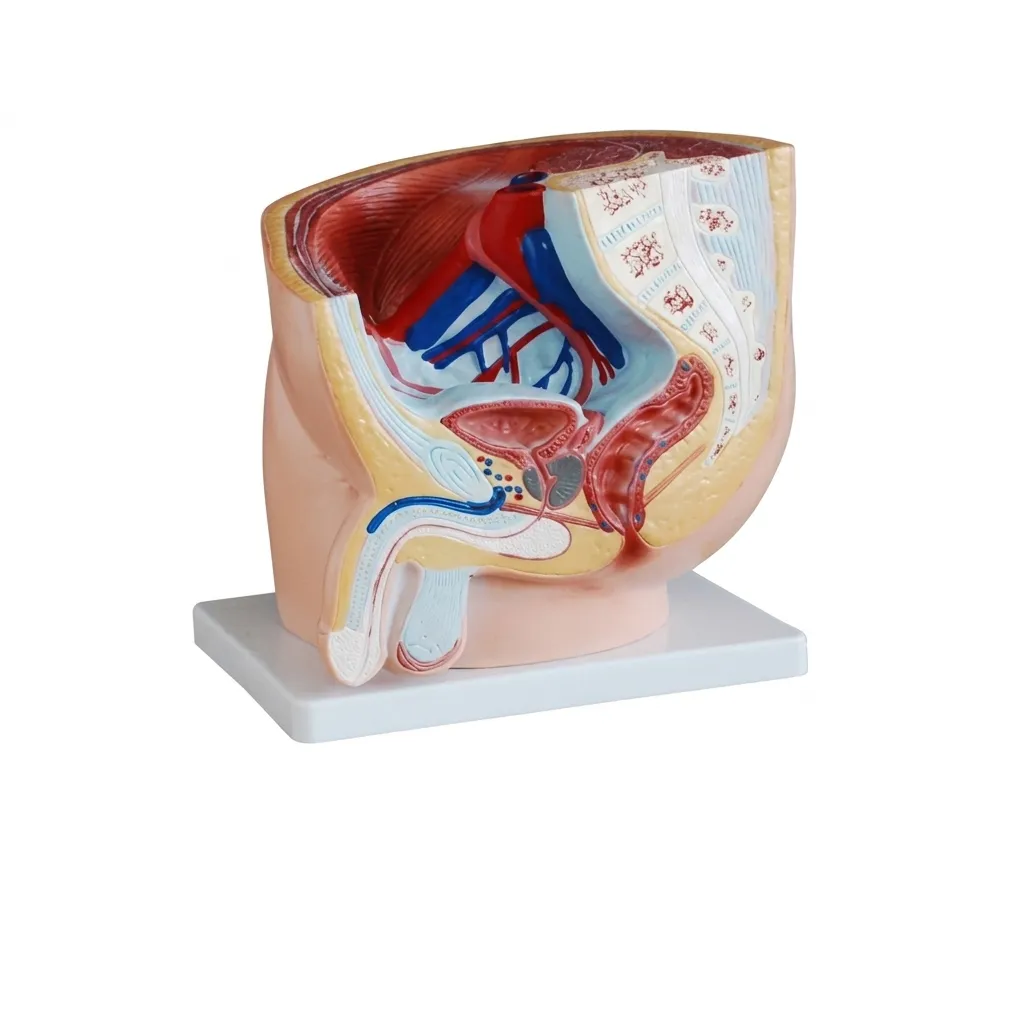
These life-size pelvic models are essential tools for understanding the structural and functional differences between the male and female human anatomy. Precision-molded from high-quality PVC, these models are designed for medical students, healthcare professionals, and educators to demonstrate pelvic alignment, reproductive health, and skeletal mechanics.
XC-123 Male Pelvis Model (Life-Size)
The XC-123 represents the typical male pelvic structure, which is characterized by being narrower, heavier, and more upright than the female counterpart.
-
Anatomical Accuracy: Features the ilium, ischium, pubis, sacrum, and coccyx.
-
Key Characteristics: Clearly demonstrates the narrow, heart-shaped pelvic inlet and the acute angle of the pubic arch (typically less than 90°).
-
Durable Build: Crafted from break-resistant PVC that mimics the density and texture of real bone.
Comparative Technical Specifications
| Feature | XC-123 (Male) | XC-124 (Female) |
| Pelvic Inlet | Heart-shaped / Narrow | Oval / Wide |
| Pubic Arch | V-shaped (Narrow) | U-shaped (Wide) |
| Bone Density | Heavier / Thicker | Lighter / Thinner |
| Scale | 1:1 Life-Size | 1:1 Life-Size |
| Material | Washable PVC | Washable PVC |
Professional Applications
-
Medical & Nursing Education: A fundamental tool for learning the landmarks of the pelvic girdle and identifying sex-specific skeletal traits.
-
Obstetrics & Gynecology (XC-124): Indispensable for explaining pelvic floor health, pregnancy, and the delivery process to patients.
-
Orthopedics & Physical Therapy: Useful for demonstrating hip joint mechanics, sacroiliac (SI) joint dysfunction, and pelvic alignment issues.
-
Forensic Science: Helps students understand how anthropologists determine the biological sex of skeletal remains.
Why Choose the XC-123/XC-124?
Whether used individually or as a comparative set, these models provide the tactile clarity needed to master pelvic anatomy. Each model comes securely mounted on a professional base or is designed for handheld study, ensuring that every detail—from the obturator foramen to the acetabulum—is easily accessible for inspection.



Reviews
There are no reviews yet.